
Reverse Osmosis System Installation in Central Florida
Reverse osmosis is the most thorough treatment you can put in a home. It takes lead, arsenic, fluoride, nitrates and sodium out of the water you drink and cook with, and it lives under your kitchen sink with its own faucet. Start with a free water test, so you know it’s the right fit.
- ✓4.9 stars from 777 Google reviews
- ✓Serving Central Florida since 1986
- ✓Licensed & insured
What reverse osmosis removes, and how it differs from whole-house filtration
Reverse osmosis pushes water through a membrane with pores small enough to hold back most dissolved contaminants. Carbon stages before and after it take care of chemicals and taste.
Lead and mercury
Heavy metals that can enter water from older plumbing and fixtures on the way to your tap. The membrane rejects them.
Arsenic
A naturally occurring contaminant that has no taste or smell. It’s more of a concern on private wells than on city water.
Fluoride
Most Central Florida utilities add fluoride. If you’d rather not drink it, reverse osmosis is one of the few home treatments that takes it out.
Nitrates
From fertilizer and septic systems, and a particular concern on wells in farming areas. They don’t show in taste or color.
Sodium
Including the small amount a water softener adds. That’s one reason softened homes often add reverse osmosis at the kitchen sink.
Chlorine, chloramine and THMs
The carbon stages take out the disinfectant and trihalomethanes, the by-products chlorine forms, along with VOCs and PCBs.
A whole-house system and reverse osmosis do different jobs. The whole-house system sits on your main line and treats every tap, shower and appliance at full flow, taking out chlorine, sediment and, with softening, hardness. It isn’t built to remove fluoride, nitrates or sodium.
Reverse osmosis is the opposite: slower and more thorough, for the few gallons a day you drink and cook with. For the whole-house side, see whole house water filtration installation.
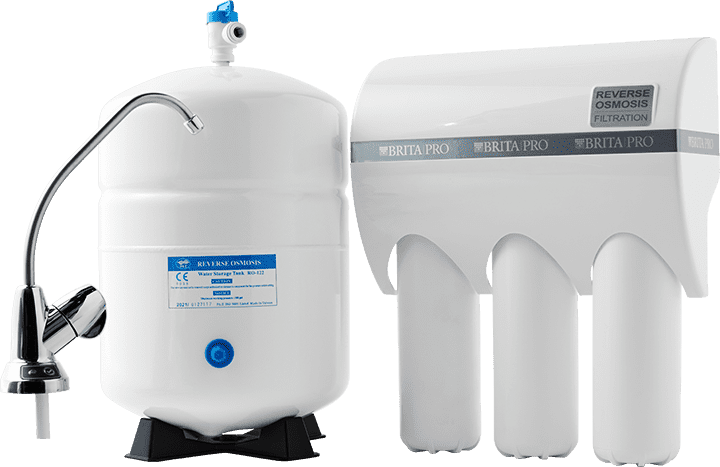
Why it goes under the kitchen sink
Reverse osmosis works slowly. The membrane makes purified water a little at a time and stores it in a small tank, ready for when you open the faucet. That suits a kitchen, where you fill a glass, a coffee pot or a pan, and it would never keep up with a shower.
The kitchen is also where the water goes into you: drinking, cooking, ice and baby formula. Treating that water to the highest standard, and the rest of the house to a practical one, is the sensible split. The system sits out of sight in the cabinet, and a slim dedicated faucet sits beside your regular one.

Reverse osmosis installation: what’s involved
One visit, under one sink. Your regular kitchen faucet works exactly as before; the new faucet beside it pours the purified water.
Test the water first
We test your water in your home. The result tells us whether reverse osmosis alone makes sense, or whether your house also needs softening or whole-house filtration.
Mount the system under the sink
The filter housings and the storage tank go in the cabinet under your kitchen sink, fed from the cold water line.
Fit the drinking-water faucet
The dedicated faucet goes in an existing hole in the sink or countertop where there is one, or a new hole where there isn’t. The drain line connects to the sink drain.
Flush, fill and check
We flush the new filters and membrane, let the tank fill, check every fitting for leaks and taste the water with you. Most installs are done in one visit.

The five stages in a Brita Pro system
Sediment
The first cartridge catches sand, rust and particles, so they don’t clog what comes next.
Carbon
The second takes out chlorine, chloramine, VOCs and other chemicals, which also protects the membrane.
Reverse osmosis membrane
Water is pushed through a membrane fine enough to reject lead, arsenic, fluoride, sodium and other dissolved contaminants.
Storage tank
Purified water collects in a small tank under the sink. The rejected water goes to the drain.
Final carbon polish
Water passes one last carbon filter on its way to the faucet, for taste.
Reverse osmosis with a whole-house system

In most Central Florida homes we work in, reverse osmosis isn’t the only treatment. The usual setup is a whole-house system on the main line and reverse osmosis at the kitchen sink, and the two help each other.
The whole-house system takes out chlorine and hardness before water reaches the membrane, which protects it and helps it last. The reverse osmosis unit then takes out what the whole-house system leaves, including the small amount of sodium a water softener adds. The result is soft water in the shower and purified water in the glass.
On a private well, iron and sulfur need treating first; our well water filtration page explains the order.
Is reverse osmosis right for your water?
A free in-home test takes about 20 minutes. You see the results and keep a copy, whatever you decide.
Filter changes, maintenance and reverse osmosis repair
A reverse osmosis system needs very little. The cartridges are the only regular job: depending on how much water you use, they last anywhere from six months to two years. The membrane usually outlasts several sets of filters.
We can change the cartridges for you, or sell you the cartridges if you’d rather do it yourself. If an older system has stopped working properly, we’ll find out why. Often it’s overdue filters; sometimes it’s the membrane or the tank. See water treatment repair for how service visits work.
Signs your system needs service
- The faucet flows slower than it used to, or the tank runs out quickly.
- The taste or smell has come back.
- You can hear the system draining constantly, even when no one is using water.
- There’s water in the cabinet under the sink.

Book your free water test
Four details and we’ll call you to set a time. Need filters changed or a repair? Call (407) 634-4345.
Central Florida homeowners
Request your free water test
No obligation, and no equipment recommended before the test.
Thanks, we’ve got it.
We’ll call you shortly to set up your free in-home water test. Need us sooner? Call (407) 634-4345.
That didn’t go through.
Please check your name, phone and email and try again, or call (407) 634-4345.
Reverse osmosis installation across Central Florida
We work out of Longwood and install, service and repair reverse osmosis systems in six counties.
On the Volusia coast that means Ormond Beach, Daytona Beach and Port Orange. In Brevard County we work in Melbourne, Palm Bay and along the Space Coast. In Lake County we cover Leesburg, Eustis and Clermont, and in Orange County, Orlando and the surrounding cities.

Orange County
View areaReverse osmosis FAQ
What does a reverse osmosis system remove?
A reverse osmosis system with carbon pre- and post-filters reduces lead, mercury, arsenic, fluoride, nitrates, sodium, chlorine and chloramine, trihalomethanes, VOCs and PCBs. The membrane handles dissolved contaminants; the carbon stages handle chemicals and taste.
Do I need reverse osmosis if I have a whole-house filter?
Not always. A whole-house system treats every tap for chlorine, sediment and hardness. Reverse osmosis goes further for the water you drink and cook with, taking out dissolved contaminants like fluoride, nitrates and sodium. Many homes have both; a water test shows whether you need the second one.
How long does reverse osmosis installation take?
Most installations are finished in one visit. We mount the system under the kitchen sink, fit the dedicated faucet, connect the drain, flush the filters and check for leaks before we leave.
How often do reverse osmosis filters need changing?
Depending on how much water you use, the cartridges last anywhere from six months to two years. We can change them for you, or sell you the cartridges if you’d rather do it yourself.
Does reverse osmosis waste water?
Some. The membrane rinses the contaminants it rejects down the drain, and how much depends on the system and your water pressure. That’s one reason reverse osmosis is used for drinking and cooking water at one tap, not for the whole house.
Can you repair my existing reverse osmosis system?
Yes, we can come out and find out why it has slowed down, started leaking or stopped tasting right. Often it’s overdue filters; sometimes it’s the membrane or the tank. If a replacement makes more sense, we’ll tell you.
How much does a reverse osmosis system cost?
It depends on your water and what else your home needs. We don’t publish a price list. We test first, then give you a written recommendation and a price for your home.
Do you install reverse osmosis near me?
We install across six Central Florida counties: Volusia, Brevard, Lake, Orange, Seminole and Osceola. That includes Ormond Beach, Daytona Beach, Port Orange, Melbourne, Leesburg and Orlando.